Most people ignore the gap longer than they should. It starts small. A tooth gets pulled or breaks badly enough that it can’t be saved. For the first few weeks it feels urgent. Then life gets busy and it becomes background noise.
Two years later the teeth either side of that gap have quietly shifted. The bite feels different. Eating certain things is a habit of avoidance now. And what would’ve been a simple fix in year one is a more involved conversation in year three.
This is genuinely the most common dental story nobody talks about. Crown and bridge treatment exists partly because of exactly this pattern, to step in before the surrounding damage compounds.
What’s Actually Driving This
Tooth loss and severe decay are more common than most people admit. Delayed dental visits, grinding, old trauma, gum disease, the causes are different, but the outcome is the same. A tooth that can’t stay the way it is.
Most adults know what a filling is. Most know what an extraction is. Far fewer know what happens between “this tooth is too damaged for a filling” and “we need to pull it.” That space in between is where crown and bridge treatment lives.
What Even Is a Crown?
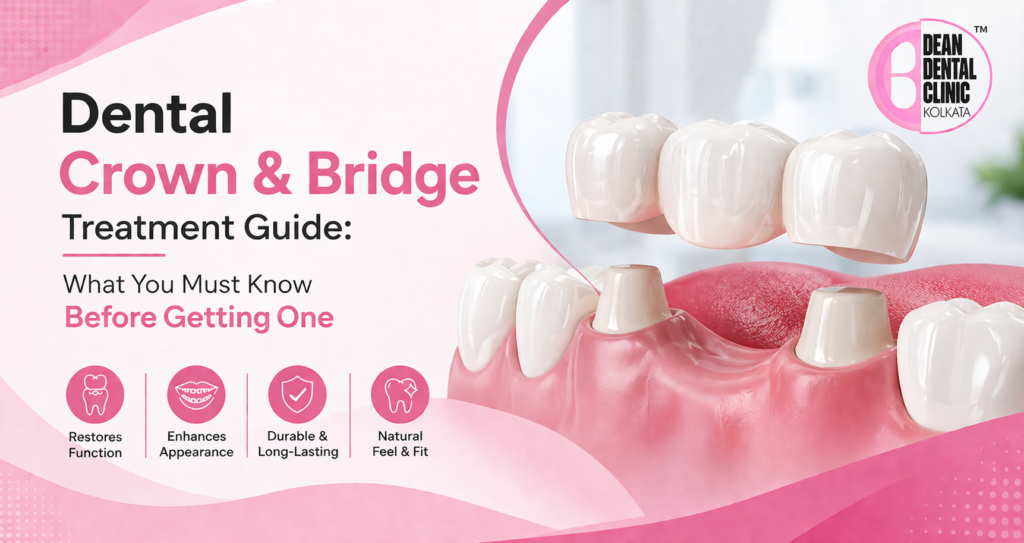
In simple and short way to explain, it’s a cap which goes over a tooth that’s damaged, cracked, heavily decayed, or structurally weak. The tooth underneath gets shaped down a little to make room. An impression or digital scan captures the exact shape. The crown gets made in a lab to match the surrounding teeth, then cemented on permanently.
Porcelain, zirconia, ceramic, metal depending on where the tooth is and what it needs to do. Back teeth handle more force; front teeth need to look right. The material choice should reflect both, not just one.
Done properly, a crown is indistinguishable from a natural tooth. More importantly, it saves a tooth that would otherwise be gone.
And What Is a Bridge?
Bridges close gaps.
A missing tooth leaves space. The teeth on either side of that space, the abutment teeth, each get a crown. A false tooth sits between them, fused to those crowns, and the whole thing goes in as one piece. Cemented. Fixed. Not coming in and out like a denture.
Crown and bridge before and after results tend to surprise people. Patients who’d stopped eating certain foods, who’d been speaking carefully, who’d stopped smiling in photos, the change in daily quality of life is bigger than they expected going in.
How Does This Compare to Just Getting an Implant?
Implants are genuinely good. For the right patient, with adequate bone volume, and a longer timeline, they’re worth the investment. But they involve surgery, require months from placement to final crown, and cost significantly more upfront.
Dental bridge treatment gets to the same outcome faster. No surgery. Two or three appointments over a few weeks. For patients who don’t want to wait, can’t have surgery, or want a more accessible cost point, a bridge is a legitimate solution that lasts well over a decade with proper care.
Partial dentures are the other option. They come out every night, can shift slightly when eating. Most people who’ve had both a denture and a bridge say the bridge feels entirely different to live with. More like a real tooth.
Crown and bridge sit right in the middle. More permanent than a denture. Less invasive than an implant. For a lot of patients, it’s the right answer for reasons that have nothing to do with compromise.
What Determines Whether It Goes Well
Abutment teeth support the bridge. If they are weak or untreated, the bridge will fail. Proper assessment is essential.
Fit matters. Even a slight misfit can change the bite and cause discomfort and uneven wear. Digital scans improve accuracy. Ask your clinic what they use.
Cleaning under a bridge requires specific care. The pontic does not get cleaned by a toothbrush. Use floss threaders, interdental brushes, or a water flosser. Without this, gum problems can develop.
Material choice matters. Porcelain fused to metal, zirconia, and ceramic have different strengths and aesthetics. The choice should depend on location and bite force.
A Few Things Worth Knowing Before You Go In
Tell the dentist if you grind or clench. It changes material selection significantly. Bring existing X-rays if you have them. Ask how many appointments and what the timeline looks like start to finish. And don’t leave the fitting appointment until the bite feels genuinely right.
FAQs:
How long does the whole process take?
Usually two to three appointments across two to three weeks. First visit shapes the teeth and takes impressions. Temporary goes in. Second visit fits and cements the permanent restoration.
How long does a dental bridge actually last?
Ten to fifteen years is the realistic range with proper cleaning and check-ups. Some go longer. The health of the abutment teeth and how well the area under the bridge gets cleaned are the two biggest variables.
Is the procedure painful?
Tooth preparation uses local anaesthesia. Some sensitivity for a day or two after is normal.
Can I see actual crown and bridge before and after photos?
Any clinic doing this work regularly should have real patient examples to show. Stock images tell you nothing. Ask for actual cases.
The Bit That Sums It Up
A gap that gets ignored doesn’t stay simple. The surrounding teeth don’t hold position politely. The bone under the gap starts changing. The bite shifts. And a two-appointment fix in year one becomes a much longer conversation in year three.
Crown and bridge treatment isn’t the flashiest option on the menu. But for a significant number of patients, it’s the most practical, most durable, and most sensible path forward. The people who come in wondering why they waited are the majority, not the exception.
Dean Dental Clinic handles the full process right from assessment, digital scanning, material selection across porcelain, ceramic and zirconia, fitting, and follow-up. If there’s a tooth or a gap that’s been sitting on the list, a thirty-minute assessment is the place to start.
Read More :
- What to Do After Tooth Removal: A Practical Guide to Healing Comfortably
- Molar Tooth Extraction: Procedure, Recovery, Pain & Essential Aftercare Guide
- How Long Does Tooth Extraction Pain Last? Complete Recovery Guide
Visit Us :