The version of dentistry most patients haven’t encountered yet, a lot of people still picture the same things when they think about a dental appointment. The drill. The needle. The sound that’s been making people tense since childhood.
Laser treatment for teeth has changed a significant portion of what we do in the clinic. Not all of it but enough that patients who come to us at Dean Dental Clinic expecting the traditional experience often leave surprised by how different it was.
Lasers are used in dentistry for a wider range of procedures than most patients realise. Gum treatment, cavity detection, tooth filling, teeth whitening, soft tissue surgery, treating ulcers and infections. Each application uses the laser differently and produces results that often can’t be replicated with conventional instruments.
What Laser Treatment for Teeth Actually is?
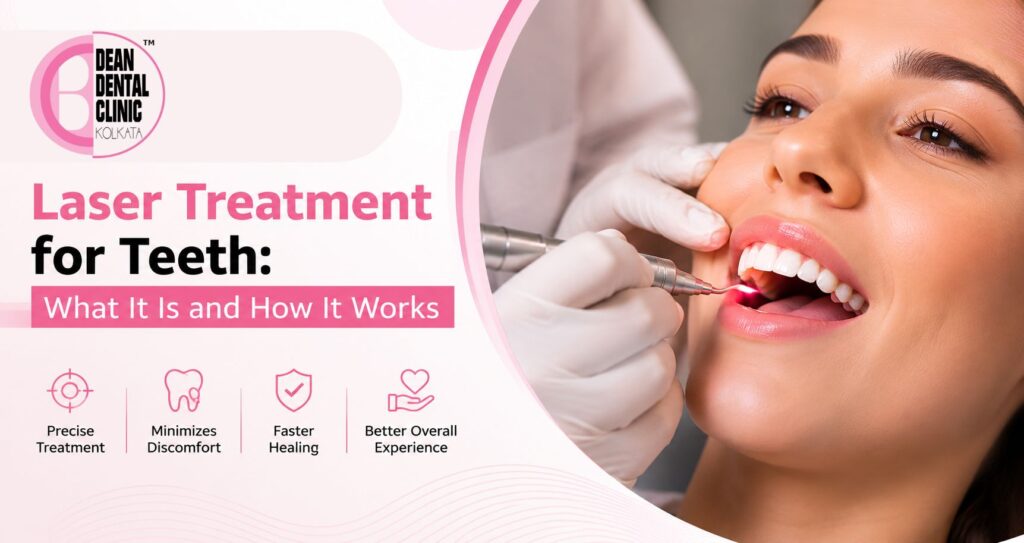
A dental laser delivers focused light energy to very precise areas of the tooth or soft tissue. Different wavelengths target different structures. Hard tissue lasers work on enamel and dentine. Soft tissue lasers work on the gums and surrounding tissue. Some lasers do both depending on their settings.
The energy from the laser can remove decay, reshape gum tissue, kill bacteria in an infected pocket, or activate whitening agents without generating the heat and vibration that traditional instruments produce.
That last point matters for patient experience. Much of what makes conventional dental procedures uncomfortable is the vibration of the drill and the pressure involved. Laser procedures often eliminate both. Less discomfort. In many cases no need for anaesthetic at all.
Is Laser Treatment Good for Teeth?
For the right application, yes. We see the results in our own patients and the evidence base for laser dentistry is strong across several areas.
Cavity treatment with a laser removes only decayed tissue. Traditional drilling affects some healthy tooth around the decay as well. The laser is more precise, which means more of the healthy tooth stays. For a tooth that will need to handle biting force for decades, preserving structure is worth prioritising.
Gum disease treatment. The laser targets infected tissue and bacteria in periodontal pockets without cutting the healthy tissue surrounding them. Healing is faster. The risk of post-treatment infection is lower. Patients we treat for gum disease with laser consistently report less post-procedure discomfort than they expected.
Teeth whitening. Laser-activated whitening allows us to work at a lower concentration of whitening agent while producing equivalent or better results. Less chemical exposure. Less sensitivity afterward.
Soft tissue procedures. Frenectomies, crown lengthening, treatment of ulcers and lesions. Laser performs these with less bleeding, faster healing, and in most cases less discomfort than surgical alternatives.
What Are the Risks of Dental Laser Treatment?
Every patient asks this and we tell them the honest version.
Laser dentistry is not without risk. Used incorrectly or on the wrong tissue, lasers can cause burns or damage. This is why the training and experience of the practitioner matters more than the equipment itself.
In the hands of a properly trained clinician, the risks are low. Soft tissue lasers can cause thermal injury if held too long in one place. Hard tissue lasers require protective eyewear for both patient and clinician. Some procedures, if the laser setting is wrong for the tissue being treated, can produce sensitivity.
Lasers also cannot perform every dental procedure. They don’t replace drills for all cavity work or for shaping crowns. They don’t work on metal restorations. Any clinic presenting laser as a universal solution for everything is overstating what the technology does.
What we tell our patients at Dean Dental Clinic is that laser is the right tool for specific procedures and we use it where the evidence and the clinical picture support it.
Is Laser Filling of Teeth Painful?
Less painful than the traditional alternative for most patients and often pain-free.
When we use a laser to remove decay and prepare a cavity for filling, the procedure generates less heat and no vibration. The pulp of the tooth is less stimulated. Many patients don’t need local anaesthetic at all for small to moderate cavities treated with laser.
For larger cavities or those close to the nerve, anaesthetic is still used. The laser doesn’t eliminate the need for it in every case. But it reduces the number of cases where the needle is necessary and reduces the discomfort in cases where it is.
What We Ask Patients to Do
Tell us about any previous sensitivity or reactions to dental procedures. This helps us calibrate settings appropriately.
Wear the protective eyewear we provide during laser procedures. This is standard and non-negotiable.
Ask us specifically which procedures in your treatment plan could use laser. Not everything should be done with laser but for procedures where it’s appropriate, the patient should know that option exists.
FAQs
Is laser treatment good for teeth?
For appropriate procedures yes. Cavity treatment, gum disease, whitening, soft tissue work. More precise, less discomfort in most cases, faster healing. Not a replacement for all conventional dentistry but a meaningful improvement for the procedures it suits.
What are the risks of dental laser treatment?
Low when performed by a trained clinician. Thermal injury if used incorrectly, sensitivity if settings are wrong for the tissue. Protective eyewear is required. Serious complications in experienced hands are uncommon.
Is laser filling of teeth painful?
Less than traditional drilling for most patients. Small to moderate cavities often require no anaesthetic. Larger or deeper cavities may still need it. The experience is consistently reported as more comfortable than patients expect.
What Changes When Laser Is Part of the Appointment
Less anxiety in the waiting room. Less discomfort in the chair. Faster healing after procedures that would have meant a swollen face and restricted eating for two days.
Not every appointment will use laser. But for the ones that do, most patients come back and tell us they wished they’d had this option years earlier. Dean Dental Clinic uses laser treatment for teeth across cavity care, gum treatment, whitening, and soft tissue procedures. If upcoming dental treatment is causing anxiety about the experience, come and ask us which parts of your plan could use laser. That conversation changes things for a lot of patients.
Read More: