Picture a bridge built on bedrock versus one built on sand. Both may look identical on opening day, yet only one survives decades of traffic. Dental implants work the same way. Whether yours lasts fifteen years or fifty depends less on luck and more on a handful of decisions made before, during and after surgery. Let us walk through them together.
How Long Does a Dental Implant Last?
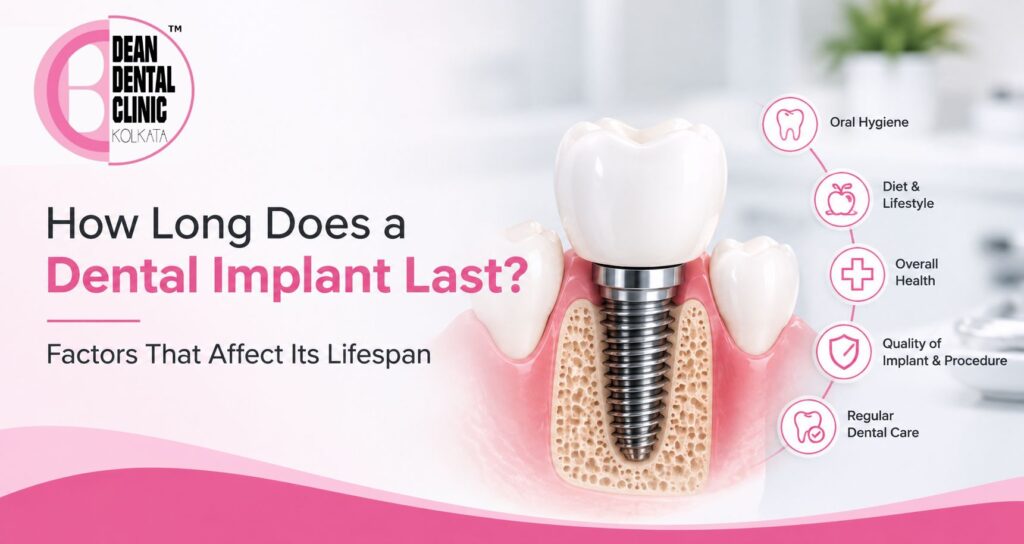
An implant is really two pieces with two different timelines:
- The anchor: A small titanium screw sits inside the jaw and becomes part of the bone itself. With healthy surroundings, it frequently outlasts the patient’s other dental work, and clinical follow-ups often report survival above 95% after a decade.
- The visible cap: The porcelain or ceramic crown handles biting and grinding every day. Expect roughly 10 to 15 years of service, occasionally more, before a refresh.
Think of it as a lighthouse: the foundation is permanent, while the lamp occasionally needs a new bulb.
What Happens to Dental Implants After 20 Years?
Two decades is a milestone rather than a deadline. A well-kept implant at that stage generally feels exactly as secure as it did in year one. Still, a few age-related details appear:
- Minor surface wear or a slightly dulled shine on the crown.
- A tiny shift in the gumline, which your dentist simply tracks.
- An older crown design that you may choose to upgrade for better colour or fit.
What truly endangers a veteran implant is not the calendar. It is peri-implantitis, an infection that inflames gum and bone around the screw. Catch it early and it is manageable; ignore it and bone can melt away.
Seven Factors That Decide Your Implant’s Lifespan
Daily Cleaning Routine
Porcelain cannot get cavities, yet plaque still irritates the gum collar. Soft brushing, floss threaders and a water flosser keep that border calm.
Tobacco Use
Nicotine narrows blood vessels, starving healing tissue of oxygen. Smokers experience more failures and faster bone loss than non-smokers, so quitting is a powerful upgrade.
Jawbone Quality
Dense bone grips an implant like firm soil grips a fence post. Thin or shrunken bone can often be rebuilt with grafting before placement.
General Health
Poorly controlled blood sugar, certain bone-strengthening drugs and immune disorders can slow recovery. Share your complete medical story during the consultation.
Clenching and Grinding
Night-time gnashing can generate far more pressure than eating. A custom-fitted guard absorbs that force, shielding the porcelain.
Clinician Experience
Angle, depth and spacing matter enormously. A skilled implantologist using premium titanium or zirconia sets the stage for long-term stability.
Maintenance Visits
Professional scaling and scheduled X-rays reveal hidden trouble, such as a slackening screw, while it is still a quick fix.
What Is the Downside to Dental Implants?
No treatment is perfect, and you deserve the full picture:
- Higher initial price: Bridges and dentures cost less today, although implants frequently prove cheaper across thirty years.
- A patient timeline: The bone needs three to six months to bond with the screw.
- A minor procedure: Expect local anaesthesia, mild swelling and soft foods for a few days.
- Rare complications: Infection, sinus involvement or an implant that never bonds can occur in a small percentage of cases.
- Eligibility checks: Active gum disease or very thin bone usually needs treatment first.
How Many Times Can a Dental Implant Be Replaced?
Dentistry sets no official ceiling. If an implant fails, the dentist removes it, allows the site to heal, and often adds bone graft material before trying again. Many people enjoy a successful second implant in the same spot. Success hinges on leftover bone volume, general health and, most importantly, why the first attempt failed. Identifying that cause, whether infection, overloading or smoking, prevents a repeat. Crowns are even simpler: they can be swapped repeatedly while the anchor stays put.
Is It Better to Pull a Tooth or Get an Implant?
Here is the honest ranking. First choice: rescue the natural tooth through a filling, root canal or crown. Nothing matches original equipment. Second choice: when the tooth is cracked below the gumline, abscessed or loosened by advanced gum disease, remove it and replace it promptly.
Delay is where problems begin. Without a root to stimulate it, the jawbone gradually thins, neighbouring teeth lean into the gap, and the opposite tooth drifts downward. Compare your replacement routes:
| Replacement Option | Approximate Lifespan | Keeps Bone Stimulated? |
|---|---|---|
| Dental implant | 25 years or more | Yes |
| Fixed bridge | 10 to 15 years | No |
| Removable denture | 5 to 8 years | No |
Because only an implant imitates a real root, it usually becomes the preferred option after extraction.
Everyday Habits for an Implant That Lasts
- Brush softly twice daily with a gentle brush.
- Clean the gumline around the implant every evening.
- Skip ice cubes, popcorn kernels and pen-chewing.
- Wear a protective guard if you grind at night.
- Book hygiene visits twice a year.
- Stay away from cigarettes and vapes.
Final Thoughts
So, how long does a dental implant last? Often longer than most people expect. The anchor can serve for decades, and the crown for a decade or more, provided you partner with a careful clinician and protect your gums. Implants ask for attention, but they reward it with a stable, natural-feeling smile. Small daily choices compound quietly over time, so start protecting your smile now.
Curious whether you qualify? Schedule a consultation at Dean Dental Clinic, and we will map out a plan tailored to your mouth, your health and your budget.
FAQs:
Can an implant truly last for life?
The titanium anchor can, as long as the surrounding bone and gums remain healthy.
Do implants hurt?
Most patients describe mild soreness that fades within several days.
Do I need special products?
Ordinary dental tools work, with extra attention along the gumline.
Is the procedure covered by insurance?
Coverage varies widely, so ask your provider and our team for a written estimate before treatment begins.
Read More: